
By Chris DeDecker · AutoMotivate
Your car is overheating with no leaks, and the coolant looks full. What’s going on?
I’ve dealt with a lot of different causes of overheating, and a full reservoir is only one part of the picture. The coolant still has to move through the engine, release heat at the radiator, and stay under the correct pressure. If one of those things isn’t happening, the temperature can climb even without a puddle under the car.
Before throwing parts at it, let’s work through the clues. Hopefully, your issue ends up being the thermostat. And let’s hope it isn’t that last one.
Watch my full overheating walkthrough
I show the parts and tests in the video below. The photos throughout this article are screen grabs from that same walkthrough.
Watch “Engine Overheating but No Coolant Leak?” on YouTube.
A stuck thermostat, a water pump that isn’t circulating coolant, restricted radiator airflow, trapped air, a bad pressure cap, or combustion gases entering the cooling system can all cause overheating. A full overflow bottle alone doesn’t prove the radiator or the rest of the system is full.
Jump to a check: Thermostat · Water pump · Radiator and fans · Trapped air · Pressure cap · Combustion-gas test · Tools
Before you replace anything, look at when it overheats
The cooling system is pretty simple in principle: coolant picks up heat from the engine, travels through the radiator, and cools down before circulating again. We love hot motors, but we don’t want them too hot. Just at operating temperature.
With the engine cold, check the coolant at the correct fill point for your vehicle. Then think about what changed:
- It gets hot at idle or in traffic: check the fans and radiator airflow. That pattern is a clue, not proof of a failed fan or water pump.
- It started after cooling-system work: trapped air moves up the list. Think thermostat, pump, radiator, heater core, hose, or coolant replacement.
- It overheats while driving, too: keep coolant circulation and radiator restrictions in the picture. Don’t assume road speed rules everything else out.
- You can’t see a leak: that doesn’t tell you whether coolant is flowing properly or the system is holding pressure.
1. A thermostat that’s stuck closed
Think of the thermostat as a cork that controls coolant flow through the radiator. It restricts that flow while the engine warms up, then opens at its specified temperature to help regulate engine temperature.
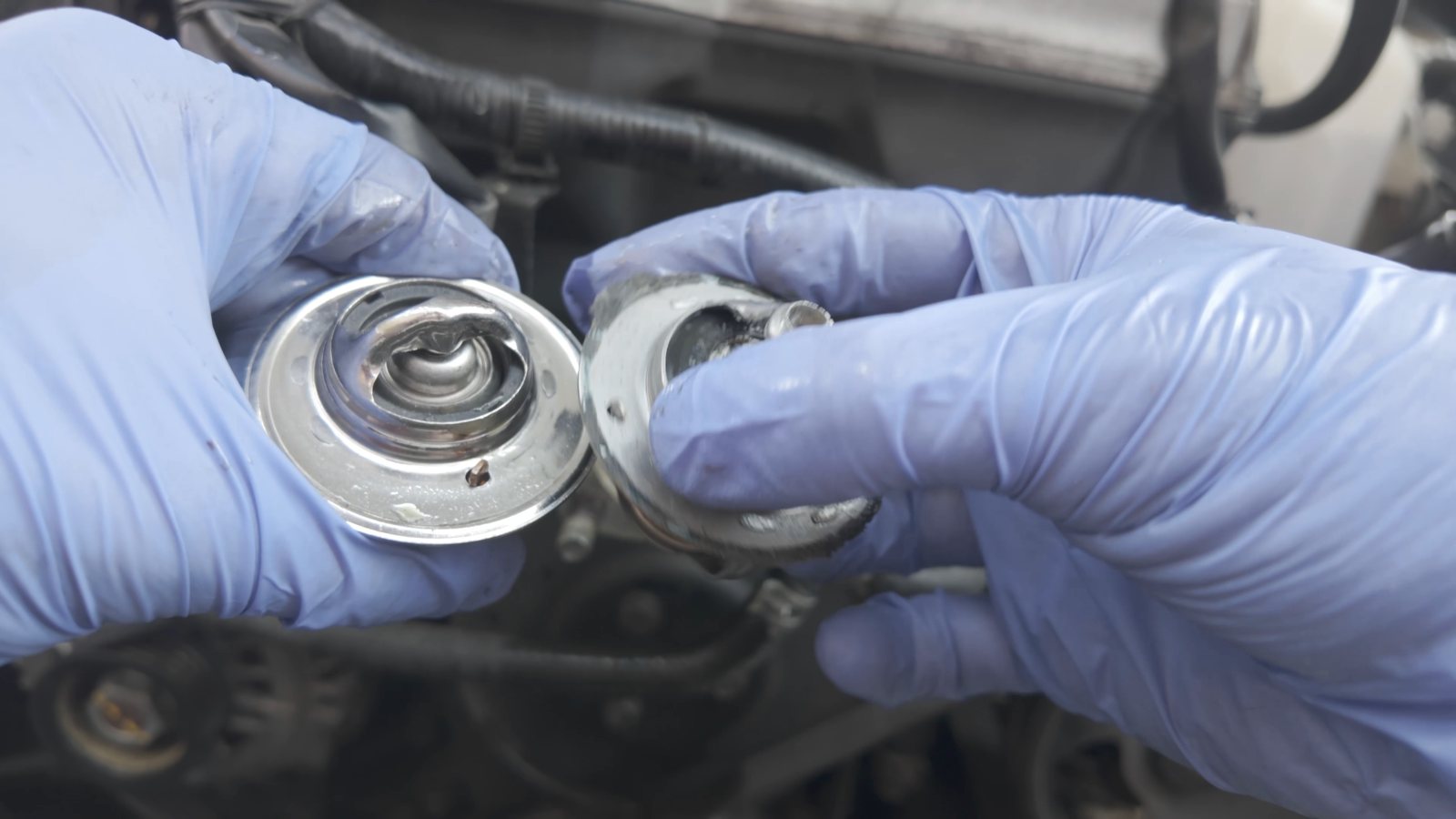
If it sticks closed, the engine can overheat because coolant isn’t flowing through the radiator as it should. But a bad thermostat doesn’t always cause overheating:
- Stuck closed: restricted radiator flow and possible overheating.
- Stuck open: slow warm-up or trouble reaching operating temperature. You may see a P0128 code.
A code is a starting point for diagnosis, not an automatic instruction to buy a part. The thermostat is worth investigating, but don’t let the engine keep overheating while you figure it out.
On some engines, the thermostat is fairly easy to access. On others, getting to the housing is the hard part. The location and number of bolts depend on your engine. After replacement, refill and bleed the cooling system using the correct procedure.
See the thermostat explanation at 0:49.
2. The water pump can fail without leaking
The water pump does exactly what you’d expect: it moves coolant through the cooling system. Inside it are blades called the impeller. Depending on the engine, the pump may be driven by an accessory belt, a timing belt, or an electric motor.
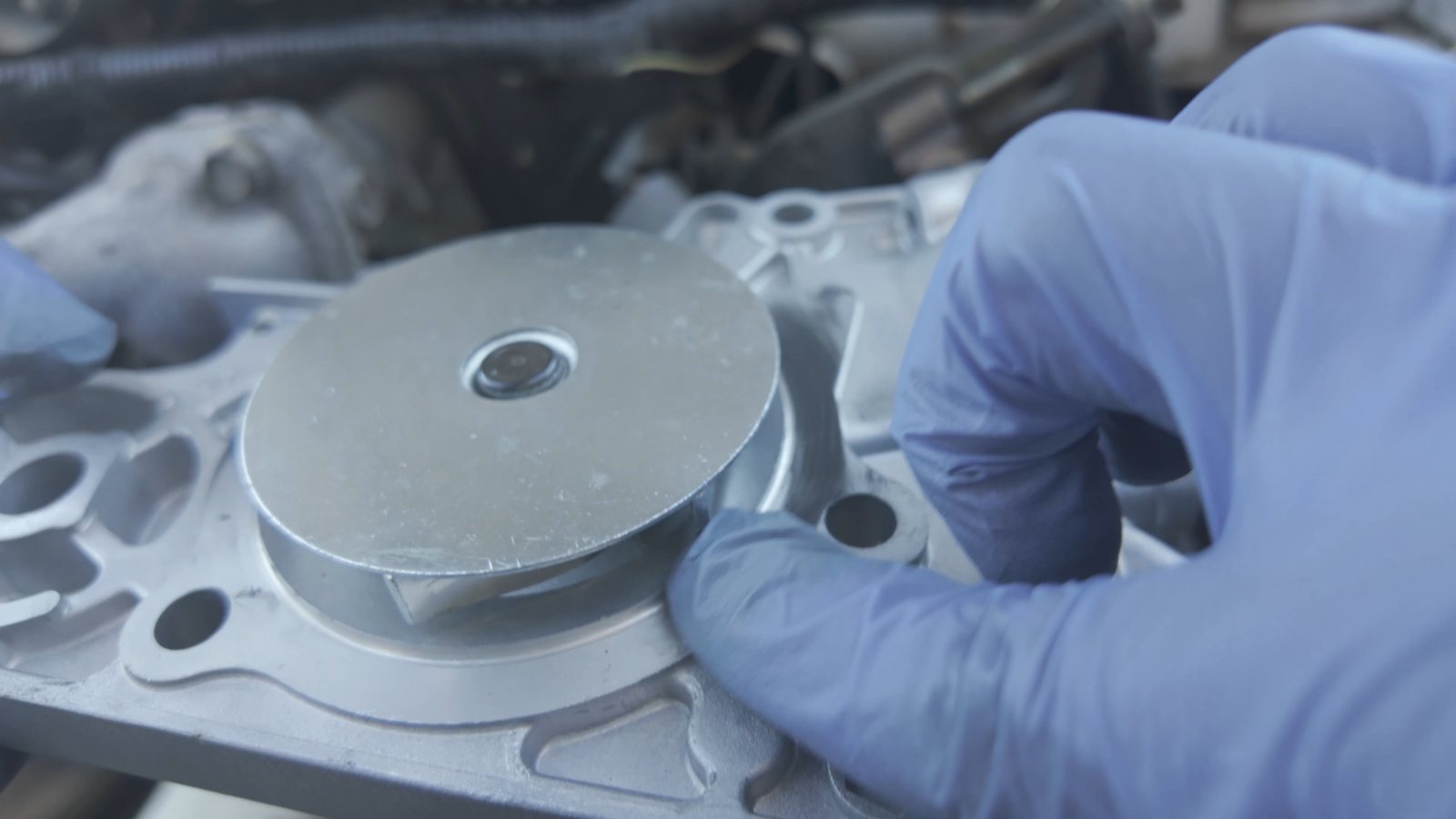
A failed bearing or seal may give you a coolant leak. But we’re talking about overheating with no visible leaks. The impeller can become damaged and stop moving coolant effectively, even if the outside of the pump isn’t dripping.
Also, overheating at idle and cooling down while driving does not identify a bad water pump by itself. You still need to check the rest of the system.
How big a job is replacement? That depends on the motor. On my Mazda Miata, the water pump is associated with the timing belt. On my Chevy Tahoe, it’s at the front of the engine. Same job in the cooling system, very different access.
Watch the water-pump section at 2:03.
3. The radiator needs good airflow
So the thermostat regulates the flow and the water pump pushes the coolant. What actually cools that fluid down? The radiator, with air moving through it.
Before blaming the fan, check for debris blocking the radiator or A/C condenser, damaged fins, and possible internal radiator restrictions. A fan can be spinning and still not have a clear path for air.
Mechanical fan clutch: my Mercedes example
My 1986 Mercedes 300D had a bad fan clutch. The engine drives the fan through that clutch, and if the clutch isn’t doing its job, the fan may not move enough air to cool the engine.
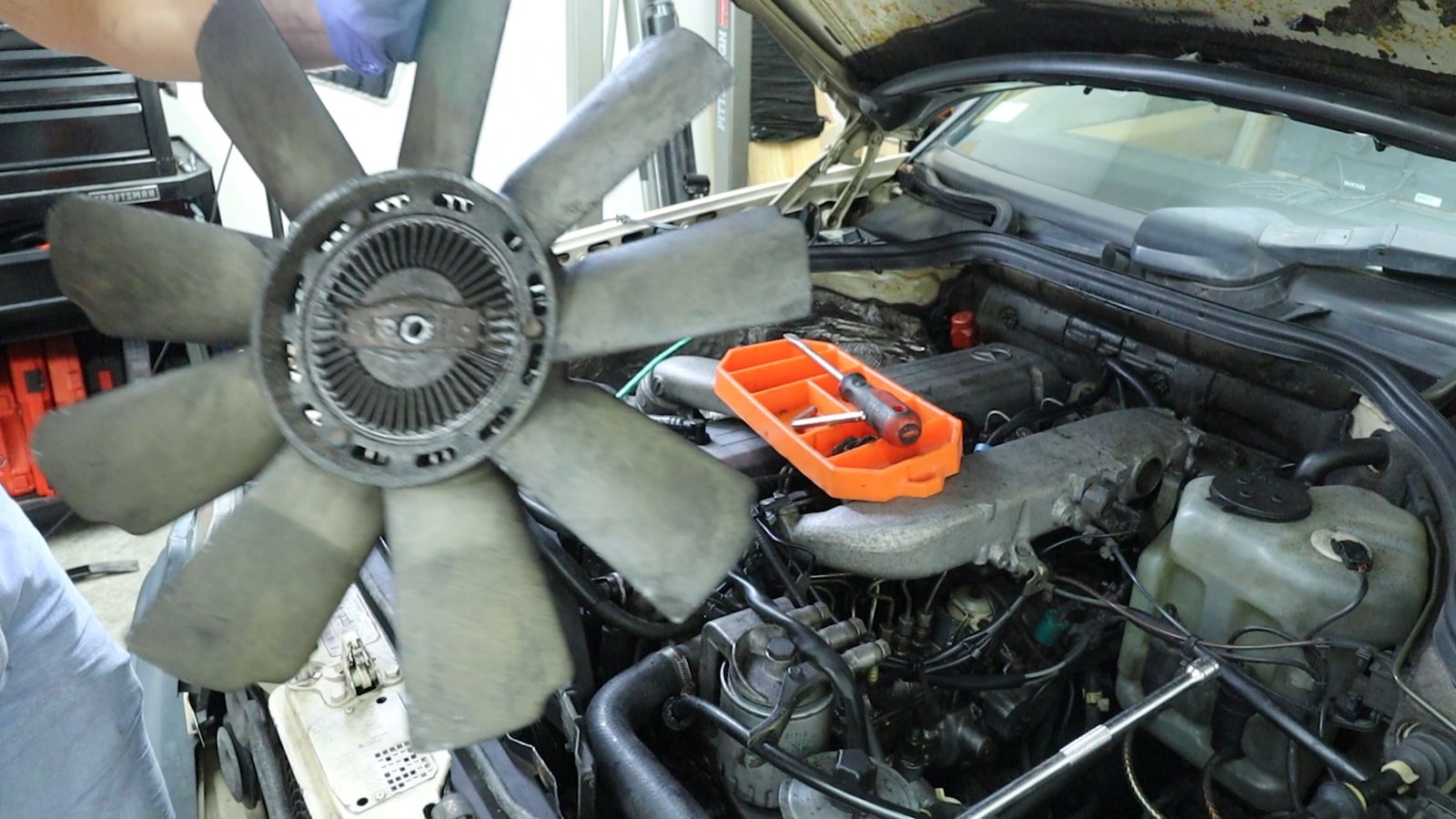
With the engine off and safely cooled down, wobble, roughness, binding, or excessive free-spinning are clues to investigate. You want smooth movement without excessive play. The expected resistance depends on the clutch and its temperature, so “one or two rotations” isn’t a universal pass-or-fail test. Follow the vehicle’s test procedure.
Electric fans: check the circuit before buying a motor
Electric fans depend on more than the fan motor. Computers, sensors, fuses, wiring, relays, and fan controllers can all be involved.
On some vehicles, switching on the A/C commands a radiator fan on. That depends on the model and conditions, though. Check what your vehicle should be doing before calling a stationary fan a failure.
If the fan won’t run when it’s being commanded on, work through the circuit using the vehicle’s wiring diagram:
- Check the correct fuse.
- Inspect the wiring and connectors.
- Test power and ground.
- Check the relay or fan controller, as equipped.
- Then evaluate the fan motor.
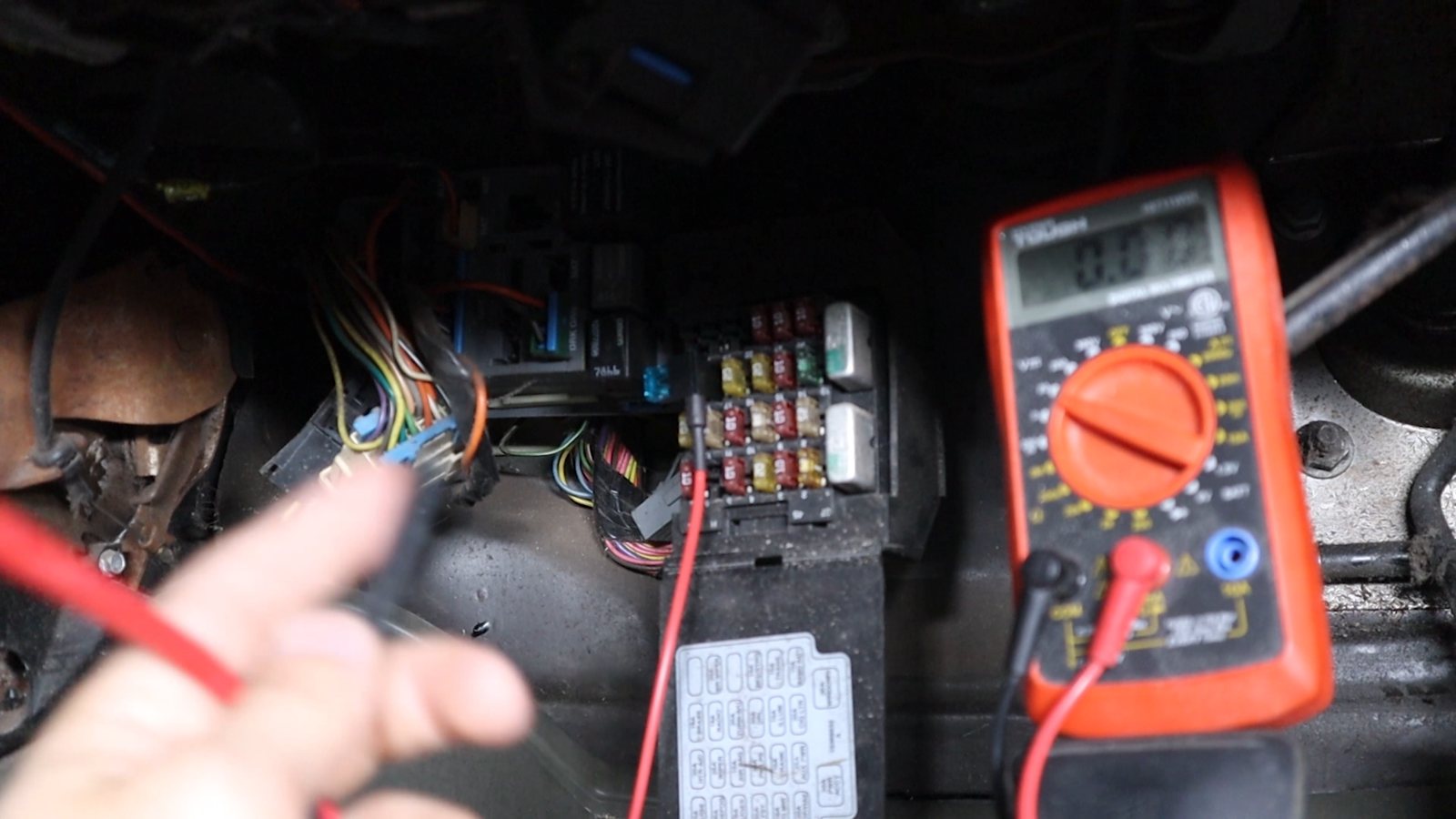
A multimeter will be your best friend here. Keep hands, tools, and clothing clear of electric fans; they can start even with the engine off.
A compatible bidirectional scanner can also help command components on during diagnosis. I cover that type of tool in my ANCEL X7 hands-on review. Don’t assume a basic code reader has the same controls—check the tool’s coverage for your exact vehicle.
A spinning fan can still be moving air the wrong way
I bought a Jeep with a fan spinning the wrong way. Correcting the reversed wiring on that Jeep sorted it out. That was an annoying issue to track down.
The point is to verify the intended airflow direction and wiring. Swapping wires is not a universal fix, especially on modern electronically controlled fans.
Watch the radiator and fan checks at 3:04.
4. Trapped air after cooling-system work
If everything has checked out so far, don’t lose all hope yet. The system might just need to be bled correctly.
Unlike humans, air is the cooling system’s enemy. Trapped air can interfere with coolant circulation. Did this start after you replaced the thermostat, water pump, heater core, radiator, a hose, or the coolant? That’s a good reason to revisit the bleeding procedure.
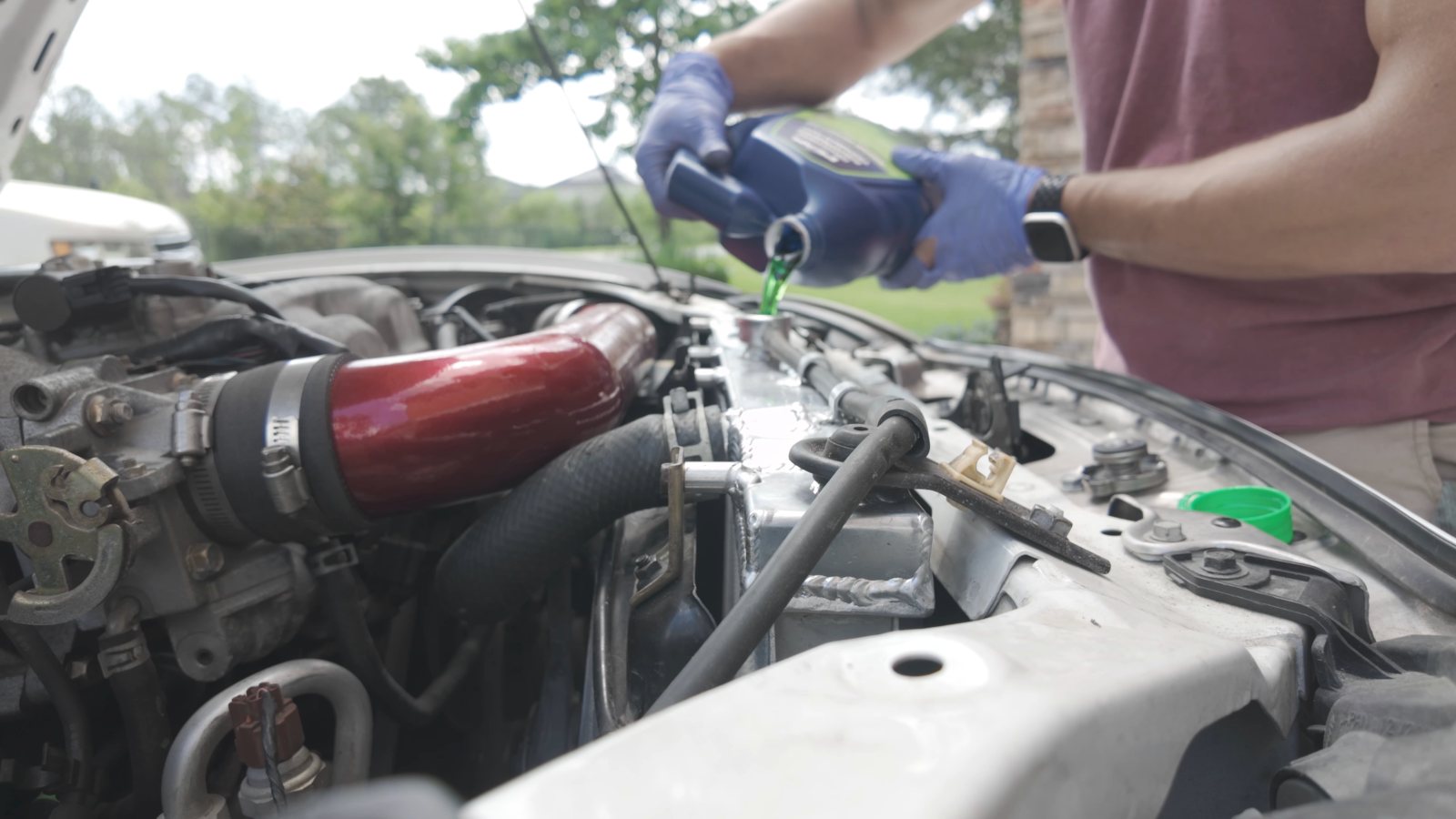
The basic bleeding process shown in the video
This is an overview for a conventional radiator-cap system. Use your vehicle’s procedure first. Some systems need bleed screws, a specific fill sequence, or a different method entirely.
- Start cold. Park as the procedure specifies. In the example, I discuss level ground or a slight upward incline and the cabin heater on maximum heat with the blower low. Remove the pressure cap only when the engine is completely cold.
- Use the right coolant. Fill with the specified coolant and mixture—commonly 50/50. A properly fitted spill-free funnel helps you monitor the level and bubbles; leave room for expansion.
- Run and monitor, if your procedure calls for it. With the correct funnel setup, let the engine idle. As the thermostat opens and coolant circulates, the level may drop. Watch the temperature. Shut it off if it overheats or coolant starts overflowing.
- Let the air work out. Top up slowly as needed. Look for steady cabin heat and a stabilizing level. Don’t squeeze hot hoses, and stay clear of fans and hot coolant.
- Cool down and recheck. Once the bleeding steps are complete, shut the engine off and let it cool before removing the funnel. Refit the cap, set the reservoir to its cold-fill mark, and recheck after a full warm-up and cool-down cycle.
Watch the trapped-air and bleeding section at 5:22.
5. Don’t overlook the radiator pressure cap
That little cap has a job. It holds the cooling system at the vehicle’s specified pressure. If it can’t hold pressure, the coolant can boil sooner. A faulty cap can also interfere with coolant recovery as the system cools.
Check the seal and gasket material for damage with the engine cold. An intact-looking cap still needs to hold its specified pressure; appearance alone doesn’t prove it’s good. Use the correct cap and pressure rating for the vehicle.
Watch the radiator-cap explanation at 7:13.
6. Combustion gases in the cooling system
Dang. Your car is still overheating? Let’s hope it isn’t this last issue, because you might have a good bit of work ahead of you.
A combustion-leak tester checks for combustion gases entering the cooling system. A head-gasket leak is one possibility. A cracked cylinder head or engine block can also cause a positive result, so the test doesn’t identify the exact failed part on its own.
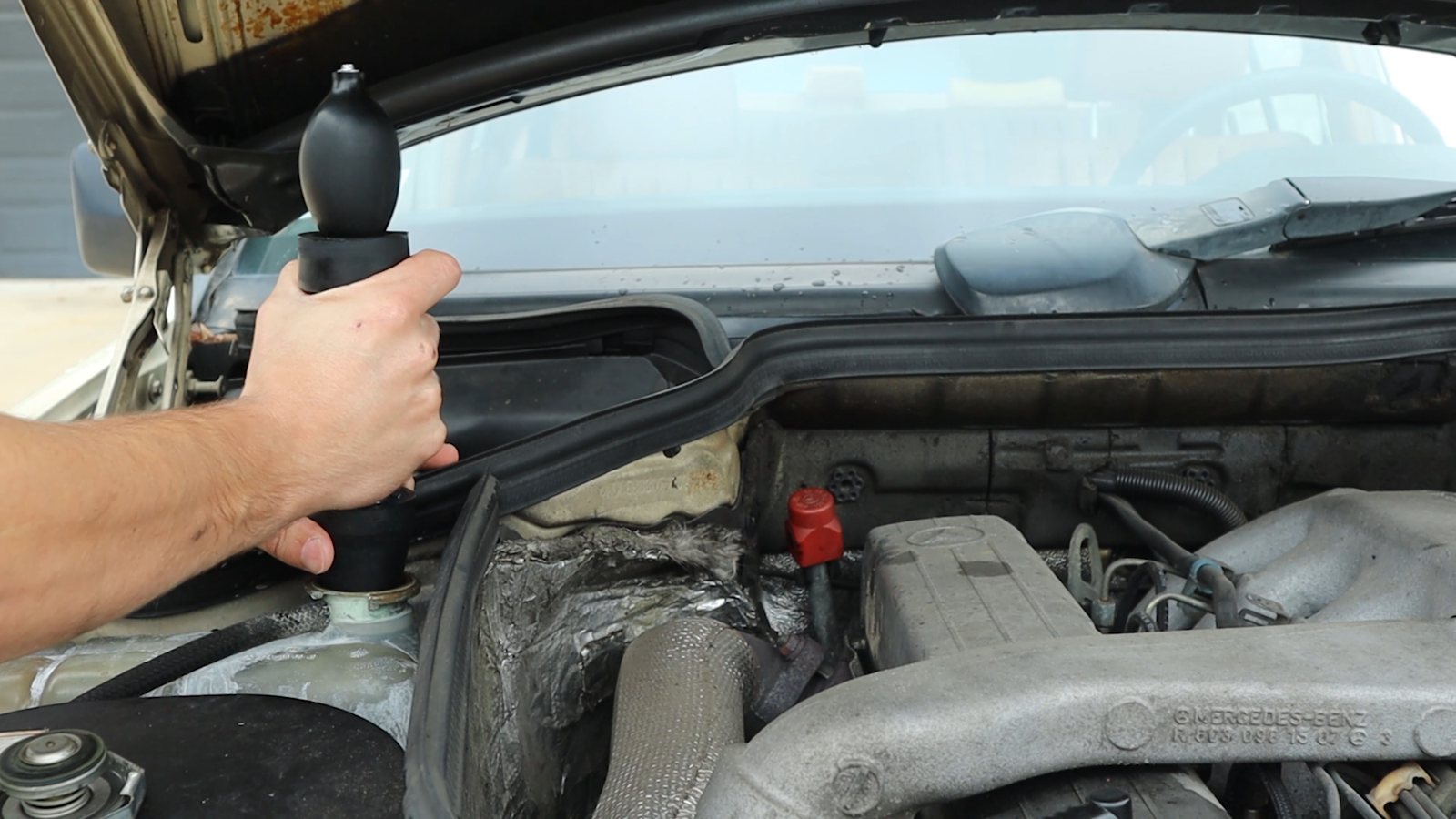
I tested my 1986 Mercedes with a kit that uses blue test fluid. Following the kit’s instructions, you seal the tester at the radiator neck or pressurized expansion tank and squeeze the bulb to draw a gas sample through the fluid. Sample air, not coolant, and follow the kit’s instructions for setup, test duration, and the positive-test color. Never open a hot pressure cap to set this up.
With the kit shown, a change toward the specified positive-test color indicates combustion gases were detected. In my test, the liquid stayed blue. Thank goodness.
That means no combustion gases were detected during that check. It does not rule out every intermittent leak or every possible head-gasket problem. A positive result—or continuing overheating despite a negative result—needs further diagnosis.
Watch my combustion-leak test at 7:51.
The tools linked in my video
Disclosure: the product links below are affiliate links. I may earn a commission if you buy through them, at no extra cost to you. I appreciate the support!
- OBDLink CX — the OBD-II reader linked in my video — handy for checking trouble codes as part of diagnosis. Check vehicle and app compatibility before buying; different versions support different makes and functions.
- AstroAI digital multimeter linked in the video — useful when checking fuses, wiring, power, and ground. Use the right meter setting and follow the vehicle’s test procedure.
For a closer look at a scanner with bidirectional controls, here’s my full ANCEL X7 review.
Common overheating questions
Can my car overheat even if the coolant reservoir is full?
Yes. The system also needs proper circulation, radiator airflow, and pressure. On systems with a separate overflow bottle, a full bottle alone doesn’t establish that the radiator is full. Check the correct fill point with the engine cold.
Does overheating at idle mean the water pump is bad?
No. Fans and airflow deserve attention with that symptom, but the pattern alone doesn’t diagnose one part. Check the fan operation, radiator condition, and coolant circulation together.
Does blue block-test fluid mean the head gasket is definitely good?
No. In my test, blue fluid meant the test did not detect combustion gases at that time. Intermittent problems can need more testing.
Before throwing parts at it
Ask yourself: is the coolant actually full at the correct fill point? When did the problem start? Is coolant circulating? Is the radiator getting airflow? Those answers give you a direction instead of a shopping list.
Hopefully this helps you narrow it down—and hopefully your issue is the thermostat. Leave your year, make, model, and when it overheats in the YouTube comments. Idle, traffic, highway driving, or right after a repair? Those details matter.
This is Chris. Always appreciate and respect one another. See you next time.